
Use the two running calculators below to help you dial in your training and goals. You can calculate your time per mile or kilometer for a standard run distance or any custom event. Below the Training Pace Calculator you’ll find additional tips for setting your training pace.
Choose either running speed calculator by clicking on the tab. Then enter either your current pace to predict your finish time or your last time to see your desired pace.
Result – Your speed per mile/KM
… hours and … Minutes more … per second …
Conclusion – Your time to finish
… hours and … Minutes more … Sec
Speed charts
Want to see a bunch of possible options at a glance? While a training pace calculator let’s you know the actual time from the meter to the marathon with hh:mm:ss, sometimes I find that we generally want to see how the pace builds. Is.
Check out these piece charts that you can easily reference as you progress.
How to Determine Your Training Pace
There are many techniques for determining your target training pace. Once you’ve used the Running Training Pace Calculator to establish a baseline per mile (either from a recent race or a goal time), here’s how to look at different workouts for your weekly training.
Remember that part of your marathon training is combining hard workouts with easy runs. Combinations when done correctly in the 80/20 (easy/hard) format.allowing you to increase total training time and speed with fewer injuries.
This is a formula that almost all top coaches use.
Recovery tour
These are the easiest and slowest types of running you will do. Often performed the day after a long run or hard workout.
Recovery runs are 2 minutes per mile or slower than a standard easy run.
Cool-down and warm-up before high-intensity exercise sessions often fall within this range. It’s about moving the body gently, but not taxing the system.
Easy run piece
80% of your total training volume as an endurance athlete will fall into this category. This is the foundation of all marathon training programs and many runners overshoot the mark by running too hard on easy days.
Speed limits are less important than focusing on the level of effort actually expended.
What feels easy one day may not feel easy the next due to changes in weather, life stress, sleep, hydration and nutrition. The goal is to focus effort at a steady pace. We call this running RPE.
This is why your easy pace can be 1 to 3 minutes per mile slower than marathon pace.
This is the long run you will do most of the time. The goal here is to increase your aerobic fitness and your fat-burning abilities, making you more efficient so you can run further.
New runners may find their easy pace to be their marathon pace. This could be because the easy runs are being done at a level that is too hard or you haven’t yet transitioned to a harder race day effort.
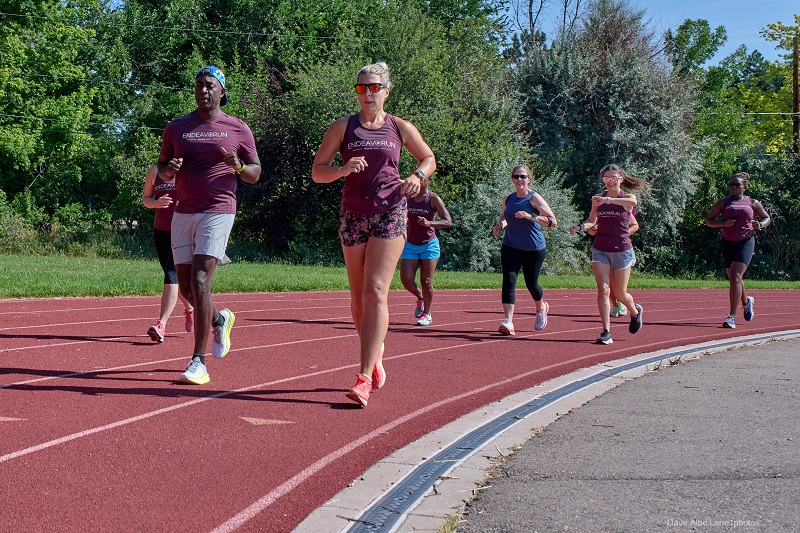
Goal Pace Runs
If you’re aiming for a new personal record, it’s important to spend time running at your goal pace. While fast runs are important, you also want to know how it feels to hit your goal pace.
This does not mean that you should start increasing this type of exercise on the first day of your marathon training. Rather, they will increase with training specificity. The duration and frequency of these runs will vary with experience and goals.
For example, working on a 1 mile time goal means doing 4 x 200m at goal pace, working up to 4 x 400m at goal pace. Meanwhile for a marathon goal pace session, you can add 2 x 1 mile at goal race pace during a 10 mile run and up to 6 miles at goal race pace during a 16 mile run.
Tempo runs or long intervals
Tempo runs are defined as the pace you can hold for an hour (although tempo runs are usually limited to 20 minutes for new runners). This is often difficult to gauge for many runners, so you can think of it as somewhere between your 10K and half marathon pace.
About 35-50 seconds faster than marathon pace.
Tempo is a type of range speed training. Thresholds are often used to describe your 60 minute run pace.
Interval training
In general, we are not talking about sprints. Instead, these are fartlek workouts or HIIT running workouts that involve repetitions of varying times or lengths.
Runners of all abilities can benefit from interval training at different speeds. Marathon runners shouldn’t overlook 5K efforts and 5K runners shouldn’t overlook some long pushes.
Pace can be anywhere from 1 to 3 minutes faster than marathon pace.
VO2-max
I hesitate to even include it because VO2 max workouts don’t apply to most people. It’s wasting your time focusing on numbers that don’t really translate to better race performance.
These intervals will not exceed 1 to 3 minutes and will be equivalent to 10-15 minutes of race pace. Which for the average runner can boost your mile pace!
This is often when you’ll hear about a lactic acid build-up. This happens when oxygen levels are low because your body can’t keep up with the intensity of the workload. You obviously don’t need to worry about lactic acid, it will do this on its own after you stop exercising.
View the full VO2 Max chart >>
Should you use pace or effort for exercise?
As a running coach, I rarely assign a specific pace to a workout. Once a runner plays around with different exercises and gets to know their body, I can give the limits as an idea. But before that, most runners get a lot out of doing effort-based exercise.
This means that if it’s 70 degrees and 90% humidity, you get the same results from the workout even if you don’t deviate from the desired pace initially. You put in the effort that will translate into your body getting faster.
For a beginner runner, this takes a lot of pressure off and often allows you to surprise yourself with what you can really achieve. We simply don’t know your ability because you haven’t had the opportunity to test it in a variety of speed form workouts.
However, this sometimes changes based on the runner and their goals. I like to spend time practicing marathon pace specific to someone hoping to break 4 hours or 3:30, etc. Despite the weather, they need to find a way to dial in the effort.
Meanwhile another day at the track, we can do our best because the workout is more intense.
Should I change my speed on the treadmill?
Treadmill training is the perfect look for a slower pace for harder workouts. Exercise wherever you can!
However, that doesn’t mean it will always feel exactly the same.
For some runners, they always feel sluggish on the treadmill. I’ve covered in-depth why this might happen, so you can read this article for ideas and tips. But here’s what you need to know in terms of training:
- Round Speed Runs We want to simulate a race course, so you may need to throw in some rolling hills with inclines.
- A short fast workout such as a mile can be done at 0% speed like running on a track.
The only difference is that the treadmill helps you maintain a constant pace without having to think so hard about it. I actually like it for having so many different types of exercise because we get out of our heads and just go.


0 Comments